The Best Nights of Our Lives Happened Around a Table
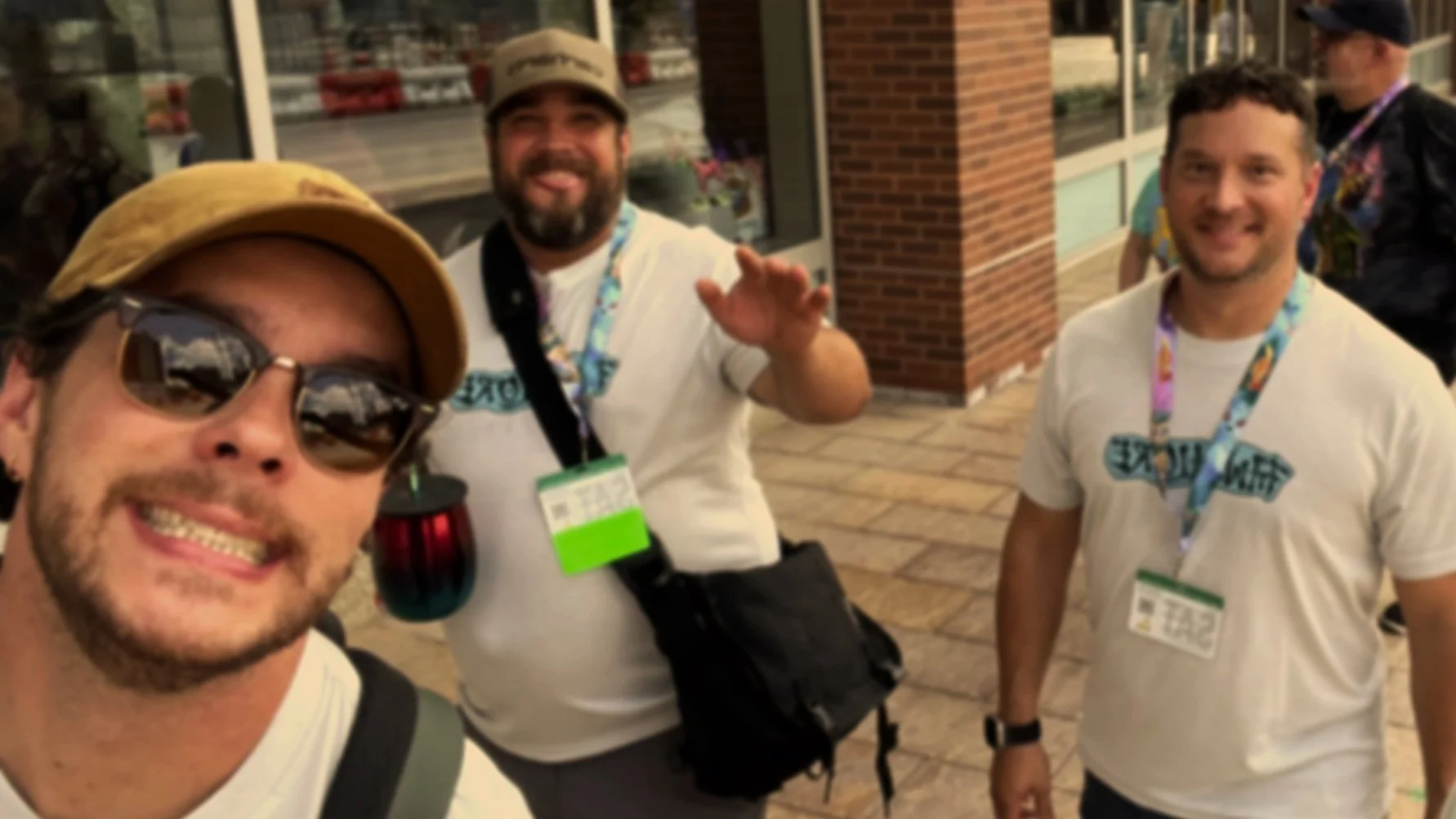
The night before the first playtest, Chad was up until 4AM finishing the decks.
He showed up to his own bachelor party already exhausted. Already second-guessing. Wondering how he was going to sit down in front of the people he loved most, explain a game that had only ever existed inside his own head, and have any of it make sense.
But as soon as we got started, there was just — an energy.
People were strategizing. Teaming up. Arguing. Someone yelled. Matt fell asleep. And somewhere in the middle of all that chaos, sitting in a little camper by the lake with all of us together, beat tired and running on nothing — we felt something none of us had expected to feel.
Joy. Pure, uncomplicated joy.
Chad still talks about that night. About what it felt like to watch something come to life that had only ever existed in his head.
I am not a naturally proud person. Confidence has never come easily to me.
But there is something that happens when you pour a year of late nights into something — when you chase an idea through every version of yourself that doubted it — and then watch it come to life in front of people you love. Something shifts. Something that is hard to name and harder to forget.
Most of my career as an engineer, I have watched my work disappear. Reviewed, revised, redirected, and eventually shelved. That is the nature of the work. You rarely get to stay attached to something long enough to see your own vision through. You rarely get to build something from nothing and execute it exactly the way you imagined it.
Designing this game is the closest I have ever come to that feeling. It is my magnum opus. The thing that combines every obsession, every instinct, every nerdy corner of my brain into a single place. Watching people play it for the first time — even broken, even chaotic, even with one person asleep — felt like the thing I had been chasing my entire career without knowing it.
We all felt the weight of that night differently. But we all left it knowing the same thing.
We had to build this.
People always ask what makes a great game night.
We have spent five years trying to answer that question through design, and here is what we have learned: perfection is the wrong thing to chase.
That first night was chaotic. The mechanics were broken. Half the rules were argued over. And we still think about it and grin.
Because what made it great had nothing to do with the game working correctly. It had to do with what was happening in the room. People were engaged. They were laughing. They were competing and collaborating and getting frustrated and coming back for more. They were present.
When someone sits down to play your game, they are offering you their time. And time is not cheap. It is the most finite thing any of us have.
But if what you give them back is a memory — something they will carry with them, something they will grin at years later when it crosses their mind — then that is a perfect exchange. That is the whole point. Not a flawless game. A formative night.
Here is something we have been thinking about for a long time.
At some point — and nobody can tell you exactly when — the world starts asking you to grow up. To put away the things that made you feel wonder. To trade imagination for responsibility and curiosity for pragmatism. To sit in the meetings and commute the commutes and slowly, quietly, stop playing.
The older we get, the more we notice it happening. In ourselves. In the people around us. The inner child doesn't disappear — it just gets buried under everything else.
But games give it back.
A great game night strips away the walls. The pretenses. The egos people carry into every room. It gives people permission to be curious again, to be competitive, to be vulnerable, to surrender themselves to something playful and alive. To disappear into their imaginations for a few hours and forget about the commute and the meeting and the thing they are dreading on Monday.
That is what we are building toward. Not just a game. An invitation.
An invitation to slow down. To be present. To play.
There are people who have spent their lives chasing versions of this.
The storyteller who understood that less is more — that restraint, not spectacle, is what creates real emotion. The world-builder who believed players should be designers, that the best games are the ones that keep giving the longer you stay inside them. The visionary who first proved that story and strategy could live in the same place, and changed everything that came after.
We think about those people often. We think about what they understood that most people miss — that the experience is everything. That a world worth entering is worth returning to. That the best games don't end when the session does.
That is what Fawnalore is trying to be.
Not a game you finish and put on a shelf. A universe you step into. A world that rewards the people who go looking, that grows the longer you stay, that feels alive in a way that makes you want to come back.
We want you to open the box and feel it. The pull. The mystery. The sense that you are standing at the edge of something much larger than what you can see from here.
That feeling — the one where a world reaches out and claims you before you even understand it — that is what we are building.
Fawnalore is almost ready to share.
Not perfectly. Never perfectly. But really — the way things are real when people have bled for them.
Stay close. There is more coming.
The Kairos is waiting.