
STEP 3: LEARN TO FIGHT
"You have found your footing. You know this land. You know how to move through it, how to gather what it offers. Now — let me show you something else. Strike This!"
MEET STUMPY
Before your first real enemy appears, you need to know how to fight.
Pona has placed something before you. A most appropriate foe. A stump. Learn the ways of the stump.
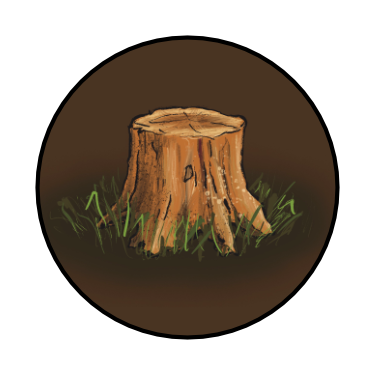
Find a Stumpy punchout tile in your box. It’s on the back of all Campfire Tiles — a simple tree stump. Choose one player to be Stumpy's controller.
Now find the Monster Deck. Stumpy has his own card in there. Pull it out and give it to Stumpy’s controller. Set the rest of the monster Deck aside for now. You won't need the rest of the deck until Episode 1.
Take a moment and read the Stumpy card together as a group.
Locate your Monster Deck. It looks like this.
In your Monster Deck, Stumpy has its own card. Pull that card out and set the rest of the Monster Deck aside.
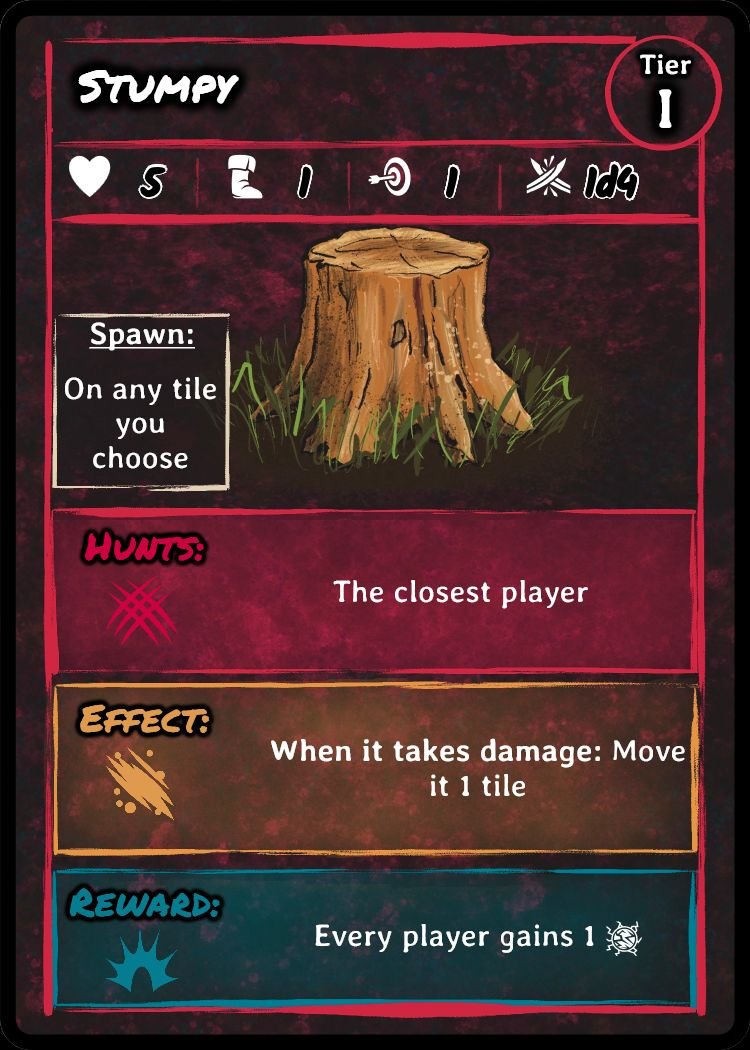
Monster Cards
Every monster card has the same structure. Let's walk through it using Stumpy as your guide.
Name & Tier
Every monster has a name and a Tier. Tier tells you how powerful it is. Stumpy is Tier I — the lowest tier. A good place to start.
Stats
Four numbers. Same icons you have seen on your own character card.
HP — how much damage Stumpy can take before it is defeated. Stumpy has 5 HP.
Move — how many tiles Stumpy moves on its turn. Stumpy moves 1.
Range — how many tiles away Stumpy can reach when it attacks. Stumpy has Range 1 — adjacent tiles only.
Attack — what it rolls when it attacks. Stumpy rolls 1d4.
Spawn - Where it goes
This tells you where the monster is placed when it enters the board. For Stumpy, the Controller decides.
In future games, Spawn tells the Controller exactly where to place the monster the moment it is revealed — before they finish their turn.
Hunts - Who it targets
When no one is in attacking range for the monster, the monster will move towards the target it hunts.
If there is a target in the monster’s range, it will always attack instead of moving. It won’t attack other monsters - only players. If multiple targets are in range, the monster’s controller can choose who to attack unless the target it hunts is also in range, then the monster would always attack them.
Effect - Monster’s Special
Some monsters have a special effect that fires when they attack, get hit, and more. This is where extra danger lives.
Stumpy's Trigger: When it takes damage: Move it 1 tile.
When Stumpy gets hit, its controller moves it 1 tile in any direction.
Reward - What happens when it dies
When a monster reaches 0 HP it is Liberated — removed from the board. This section tells you what reward the defeating player earns.
Stumpy's Defeat: All players gain 1 Ether.
The Monster Mat
Find your monster mat — the color-coded mat that belongs to your character.
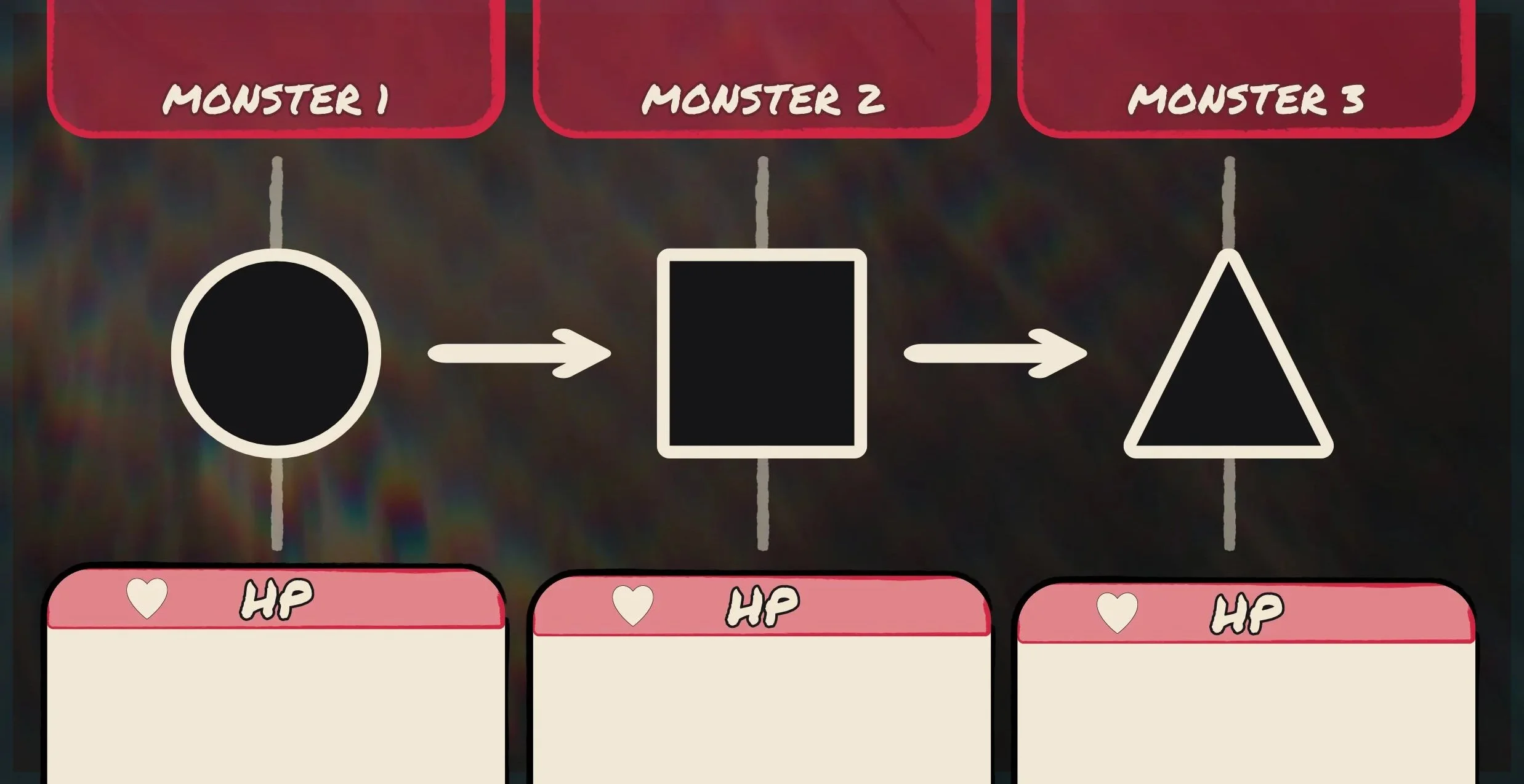
Your monster mat has three zones running top to bottom: Monster 1, Monster 2, and Monster 3. Each zone has a shape in the center — Circle, Square, and Triangle. That shape is the standee you will use for that monster on the map. Each zone also has an HP tracking area on the left where you write the monster's current HP with your dry erase marker.
Stumpy belongs to his Controller. That player does the following right now:
Slot the Stumpy card into the Monster 1 zone on the right side of their mat
Write Stumpy's HP — 5 — in the HP field of the Circle zone
Take the Circle standee and put the Stumpy punchout in the stand. Place the stand anywhere on the board.
The Standee System
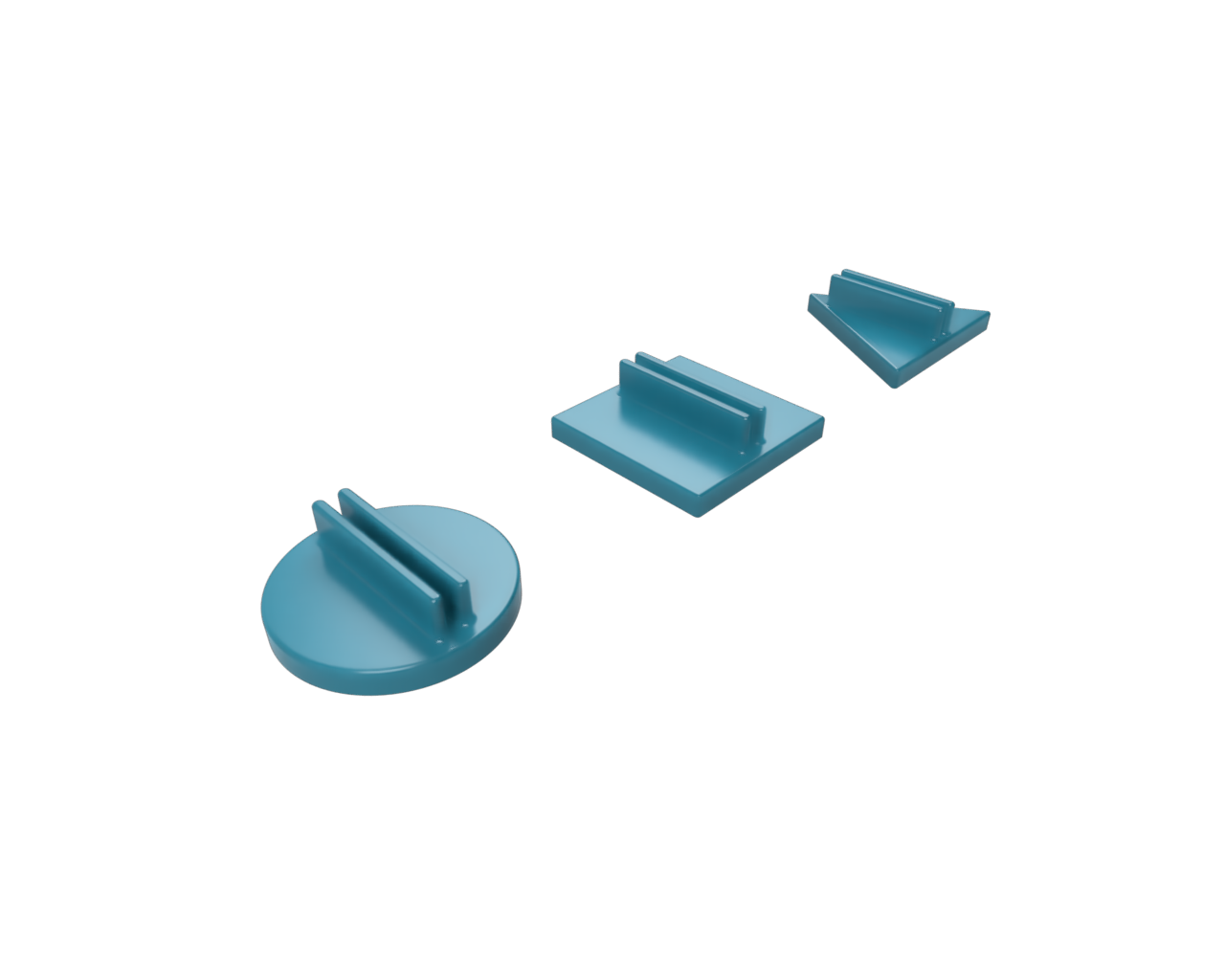
Your colored standees tell everyone at the table whose monsters are whose. The color of your standee matches your monster mat — that is how players identify ownership at a glance. Blue for Amka. Black for Shima. So on and so forth.
The shape tells you turn order when multiple monsters are in play:
Circle acts first
Square acts second
Triangle acts third
Your first monster always gets the Circle standee. Your second gets Square. Your third gets Triangle. Simple sequence, always the same.
For now Stumpy is in the Circle standee. One monster. Easy.
How to Attack
"Do not overthink it, Shima. Find your range. Strike!"
Attacking is an Action. You spend your one Action for the turn to attack.
Here is how every attack resolves — against Stumpy, against any enemy.
Step 1 — Declare your target. Choose what you are attacking. It must be within your Range. Count the tiles between you and the target — not including the tile you are standing on. If that number is equal to or less than your Range stat, it is a valid target.
Step 2 — Roll your Attack die. Roll the die shown in your Attack stat on your character card. Add any modifiers from equipped cards or abilities. (1d4 means roll the 4-sided die. 1d6 means roll the 6-sided die.)
Step 3 — Deal damage. The total is the damage you deal. All attacks in Fawnalore automatically hit — there is no miss chance. The roll determines how much damage, not whether it lands.
Step 4 — Reduce the target's HP. Subtract the damage from the target's current HP. Update the HP tracker on your monster mat.
Step 5 — Check for defeat. If the target's HP reaches 0 or below, it is defeated. Excess damage is ignored — it does not carry over.
Those five steps are how every single attack in Fawnalore works. Against monsters. Against players in PVP. Always the same sequence.
Training Round
Time to try it.
This is a training exercise. The goal is simple: every player takes a turn and attacks Stumpy at least once. You can ignore damage dealt to Stumpy for now. Go through the steps. Get comfortable with the sequence. Pay attention to Stumpy’s Effect!
Here is what each player does on their turn:
Draw a card
Move toward Stumpy if not already in range
Declare Stumpy as your target
Roll your Attack die (add any modifiers from cards you have equipped!)
Deal that much damage and update the HP tracker on the Controller's mat
Resolve any Clean Up effects
The Monster’s Turn
Hunts: The closest player (move towards closest player and/or attack)
Once every player has taken a turn and Stumpy has taken his, the training round is complete. Reset Stumpy's HP back to 5 on the monster mat.
Practice Round
Now do it for real.
Take a full round of turns in normal order. Draw, move, act, clean up. Use your Action to attack Stumpy. Play until Stumpy’s HP reaches 0 is defeated.
Liberation
When Stumpy's HP reaches 0 he is Liberated.
Remove the Stumpy punchout from the map and place the Circle Stand back on your monster mat
Remove the Stumpy card from the monster mat
Erase the HP from the Circle zone
Read Stumpy’s reward.
When more than one monster is in play during Episode 1, each monster takes its turn in shape order — Circle first, then Square, then Triangle. The Controller resolves each one fully before moving to the next. You will see this in action very soon.
"Now you know what it feels like to be on both sides of a fight. Good. You will need that. Even a stump deserves a clean end"
Final Tips & Rules
You are almost done with the tutorial and will be playing Episode 1 in no time! Before we have you start setting up for Episode 1, a few more tips and rules…
Reaction - Remember that little reaction bubble on your character card? This is to keep track of a special phase available to you. Your Reaction is for playing Reaction Cards. These are special Relic cards that can be played at any time - even when it’s not your turn. You have ONE reaction PER ROUND (a full round is when every player and monster takes their turn). Use your Reaction wisely!
Abilities - Don’t forget about your character’s abilities. They are there to help you out in ways specific to you.
Playing Cards - Remember, spending ether and playing cards are not actions! Feel free to spend ether and play cards at will. Your only limit is your Relic Slots stat.
Have Fun! - Fawnalore was designed to be as fun as possible no matter who is playing it. There are very few rules in Fawnalore that can’t be bent. No need to argue over phrasing and what something means. Just make a call at the table, move on, and keep on having fun. We won’t tell anyone. If you ever get stuck, visit our online rules Codex for quick answers!
"You are ready. More ready than you know."
You now know everything you need to play Fawnalore.
You know the world. You know how to move through it and gather what it offers. You know how to take a turn. You know how to fight.
What comes next is not a lesson. It is an adventure.