Designing The Living Board
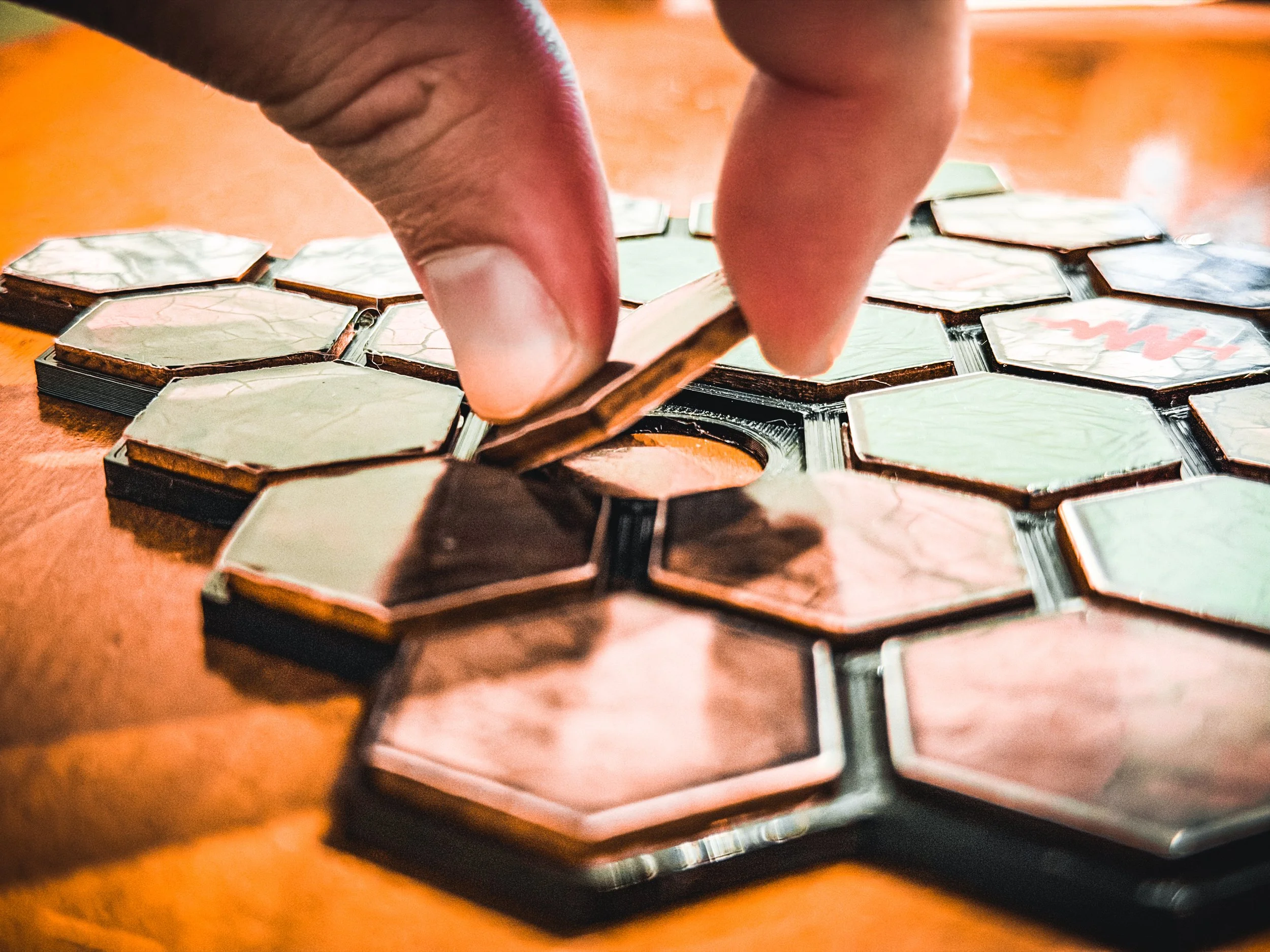
What if the Board Wasn’t Static?
Most board games aren’t designed to feel like sandbox systems. The board is static.
There’s one correct way to set it up, one way to play it, one predictable rhythm.
Sure, there are exceptions — games like Risk or Pandemic that offer starting variability, or modular classics like Catan and Spirit Island. But even then, once you’ve seen the map, the mystery is gone.
We started asking:
Why wasn’t there a game that felt truly different every single time you played?
That question led us down a design rabbit hole — one that would change how we thought about what a board game could be.
The Spark — When the Board Became a Character
The idea started with a memory: running a D&D campaign on a simple hex-grid mat, using hand-built terrain and mini-worlds.
At one point we realized, this grid is already telling the story.
Every new location we sketched, every tile we placed, shaped the players’ choices.
So we wondered — what if the board itself was alive?
What if we could create a LEGO-like system for storytelling? Something modular, cross-compatible, and endlessly adaptable — where every space mattered, and every tile felt like a tiny piece of code in a larger system?
We even explored 3D prototypes for a while, but learned quickly that vertical complexity slowed the magic. (Though who knows… maybe Fawnalore 3D one day 👀).
We pivoted to something simpler — and found beauty in that simplicity.
Our biggest challenge became this:
How do we simulate the vastness of an open-world video game in two-dimensional physical space?
Designing a Living System
We drew inspiration from the old-school simplicity of Contra, Ikari Warriors, Battletoads, and the world-building freedom of Minecraft.
Those games proved that vast experiences don’t require photorealism — they require imagination and interaction.
We applied that same principle:
Elegantly simple systems that feel infinitely deep.
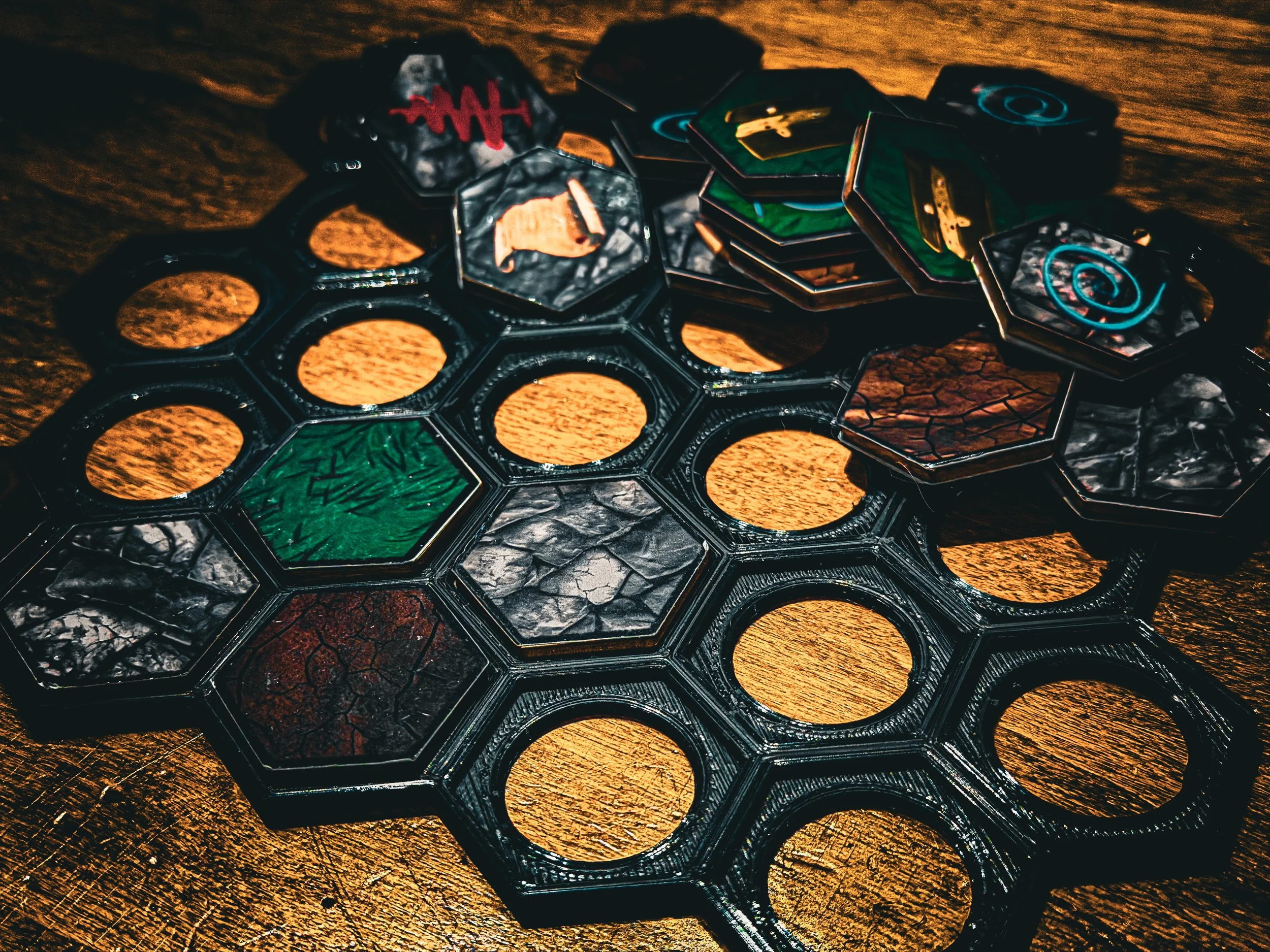
That’s when we landed on the idea of the modular tile tray system.
By standardizing trays as the “building blocks” of the world and designing tiles that could slot in and out, we could create near-infinite layouts.
Each tile became its own meaningful space — a resource, an event, a monster, a memory.
In a sense, every tile became a pixel in a 2D simulation of an open world.
Zeroes and ones replaced by cardboard and color.
When the World Came Alive
In our first prototype — the infamous doormat version — tiles were single-sided.
Every resource, event, and enemy was visible from the start.
It was meant to encourage strategic planning… but instead, it broke the magic.
Players simply avoided the risky spaces.
Every Event tile became a red flag.
All that time spent writing Event cards — and nobody wanted to land on them.
Out of that frustration came the breakthrough:
What if they didn’t know what was under the tiles at all?
The next version of the board was built with hidden tiles.
When we playtested it, something incredible happened.
The first time a player flipped an Event tile, the table erupted:
“Events Deck! Events Deck!”
It became a chant — a ritual.
Even though the odds were 50/50 (good or bad), the unknown made it exciting.
It’s funny how psychology works: when people know the outcome, they avoid risk.
When the same odds come as a surprise, they chase it.
That’s when we knew the system worked.
The board itself had become a storyteller.
The Beauty of Adaptability
The living board does more than surprise — it gives you control.
Add or remove tiles to create new modes.
Tweak the terrain to balance a competitive match.
Rearrange the map entirely for a co-op campaign.
Like a sandbox video game, Fawnalore’s system encourages tinkering and imagination.
It’s stable enough to support countless setups, but flexible enough to never play the same way twice.
And yes, that balance took a lot of late-night engineering arguments over hexes and harmony.
The Heartbeat of the Game
Every time a player flips a tile, the world exhales — revealing something familiar and strange all at once.
That heartbeat is what we’ve been chasing for four years.
The feeling of exploration, curiosity, and controlled chaos that makes the world feel alive.
We’re still refining that heartbeat — but every playtest brings it closer.
Join the Design Journey
We’re continuing to tune Fawnalore’s living system — and we’d love to bring you along.
Follow our Journal for more Tech Tuesdays, where we’ll keep revealing the design process behind the storytelling strategy game we’re building.
Help us shape a world that truly responds to its players.
[Closing Photo Anchor: Playtest candid]
📸 Suggested photo: The three of you testing or laughing around the board.
🗂 Filename: fawnalore_journal_playtest-team_2025-11.jpg
🖋 Alt Text: “The Fawnalore team refining the living board system during playtesting.”